Case Study
The Empowerment Paradox
How Danecourt School gave teachers ownership of their development, without letting go of accountability
Danecourt School · Special school, Kent · Part of Maritime Academy Trust

5
year partnership with IRIS Connect
290
pupils with complex needs
2
coaching routes built on IRIS Connect
100%
of 17 teachers rated it useful for their CPD
The School at a Glance
School: Danecourt School, part of Maritime Academy Trust
Setting: Special school in Kent, with around 290 pupils with complex needs, the majority autistic and most non-verbal
Workforce: Teachers, a therapy team, and around 120 teaching assistants, organised across four curriculum tracks (the school’s term for its curriculum phases): Enquire, Explore, Discover, and Engage
The Paradox: Wanting Ownership, Needing Accountability
For years, the same teachers came up in the same conversations. Leaders at Danecourt would carry out a learning walk, give feedback, and return a term later to find that little had changed.
Teachers improve fastest when they own what they are working on, rather than being told what they are not yet good enough at. The EEF’s guidance on effective professional development points to the mechanisms, like goal-setting and revisiting prior learning, that help new training stick. Yet leaders still carry responsibility for the quality of teaching across a whole school, and, in an Ofsted window, the need to evidence it.
This is the paradox Danecourt School set out to resolve. How do you hand teachers real agency over their own development while keeping the accountability that assures quality for every child? Lean too far towards freedom and standards drift; hold on too tightly and nothing changes. As Lou Elliott puts it, the question underneath everything is simple:
“Is it done with a person, your CPD, or is it done to that person?”
— Lou Elliott, Assistant Headteacher, Danecourt School
The Old Way: When ‘Done To’ Wasn’t Working
Before the pandemic, Danecourt ran a traditional model of quality assurance: formal observations twice a year on a set date, with learning walks in between. A leader would go in, give feedback, and the teacher would take it away. Some change was seen and sustained, but not at the level they knew it could be.
"We found that really similar themes would appear in feedback over the year and we knew there must be a more effective way of sustaining improvement."
Matt Smith, Deputy Headteacher, Danecourt School

The Catalyst: A Big Blue Suitcase
The turning point arrived, as it did for many schools, in lockdown. With classroom bubbles off limits, leaders at Danecourt needed a way to see how teaching and learning were going without being in the room, something especially important in a special school. In 2020, they invested in IRIS Connect and its “big blue suitcase” of recording kit.
Danecourt made a strategic decision at that point to use IRIS Connect so that teachers could record their practice and share it with colleagues and line managers to improve practice. As this process evolved, something unexpected took hold: teachers began recording their own practice and sharing it with colleagues to reflect on together.
"What grew legs for us was teachers making recordings of their own practice: things they needed help with, and things they wanted to celebrate."
Lou Elliott, Assistant Headteacher, Danecourt School
The Realisation: Ownership Was the Difference
As the school came out of lockdown, leaders noticed something that reframed everything. The real improvement in teaching was not coming from the formal observations at all.
"I've never had a formal observation or a learning walk in my life... so why can't we presume competence?"
Lou Elliott, Assistant Headteacher, Danecourt School
The Decision: Nailing Their Colours to the Mast
After six months of honest debate, the leadership team made a bold choice. They retired the old monitoring cycle, the document that set out which learning walks happened in which term, and committed fully to a model built on coaching and teacher ownership.
"You choose your step, you make a new video... keep changing one thing, one thing, one thing."
Matt Smith, Deputy Headteacher, Danecourt School
What Made the Model Stick: Two disciplines underpin Danecourt’s approach, and both are built into the school’s IRIS Connect Pathways.
Deliberate Practice
Instead of a "scattergun" approach to targets, the focus must be on mastering one specific area over multiple terms.
Linking to PDCs
Video reflection feeds directly into the formal Professional Development Conversations, so development stays evidence-based and aligned with each teacher's needs.
The Solution: Two Routes, Built With IRIS Connect
Working with IRIS Connect, Danecourt designed two bespoke development routes, built on IRIS Connect’s Pathways, that run alongside each other across the year. Together they let the school hold agency and accountability at once, rather than trading one for the other.
A reflective coaching route. This begins with a Professional Development Conversation. Crucially, the focus is no longer a teacher’s career ambitions or the next course they fancy. It is a specific element of their classroom practice, here and now. The teacher selects that focus on IRIS Connect, records a video of it in the classroom, and both teacher and coach complete pre-meeting tasks before they meet to learn from success, examine a challenge, and agree on a single action step. The teacher then records a deliberate practice video showing the change. Coaches are leaders who genuinely understand the curriculum track they oversee (the school groups its pupils into four such tracks) and the children in it, working as track leads and assistant heads, so the support is expert and contextual.
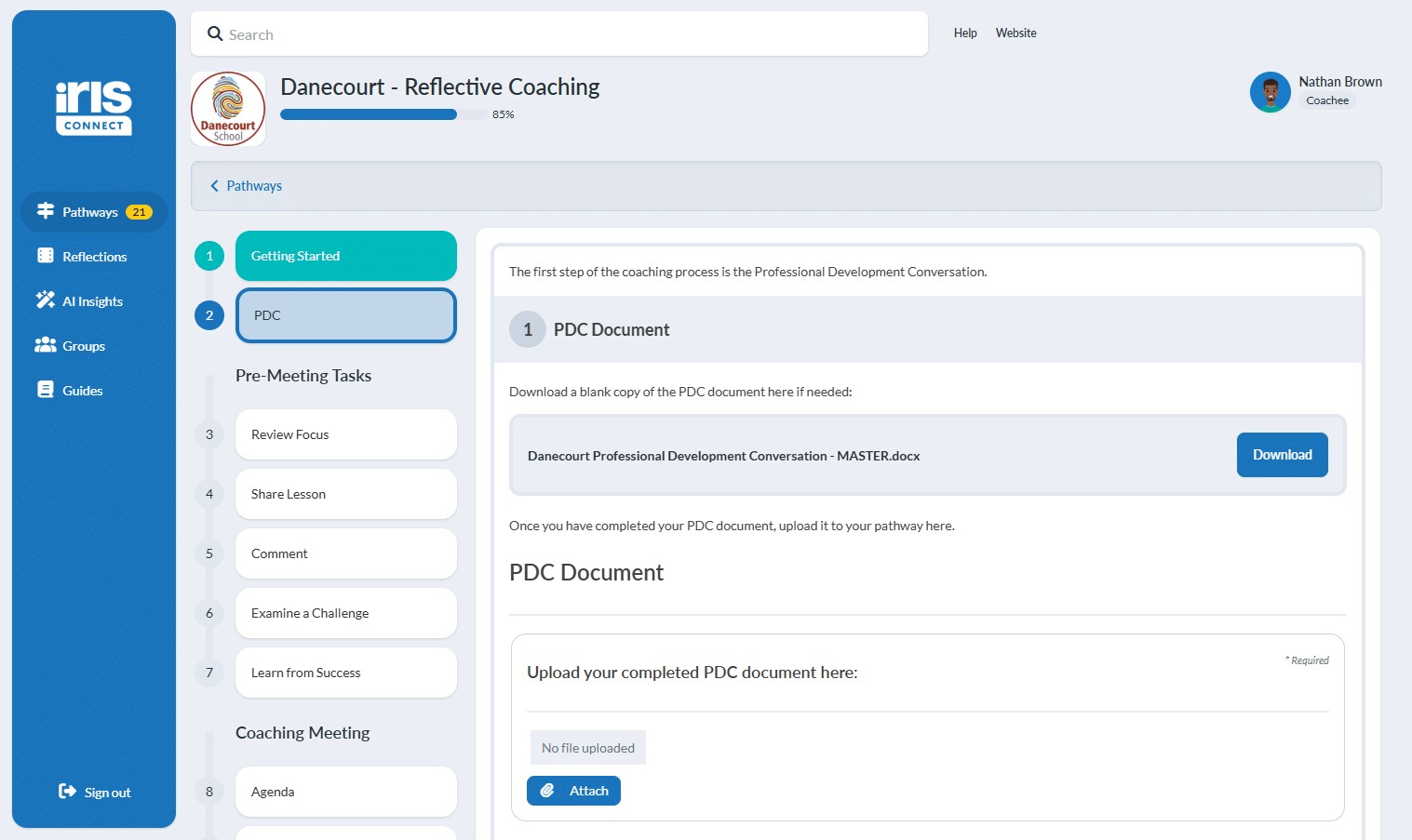
Danecourt School’s bespoke reflective coaching Pathway
A peer review and collaboration route. Running in parallel, this brings the same video to a deliberately mixed group, set in September and kept consistent.
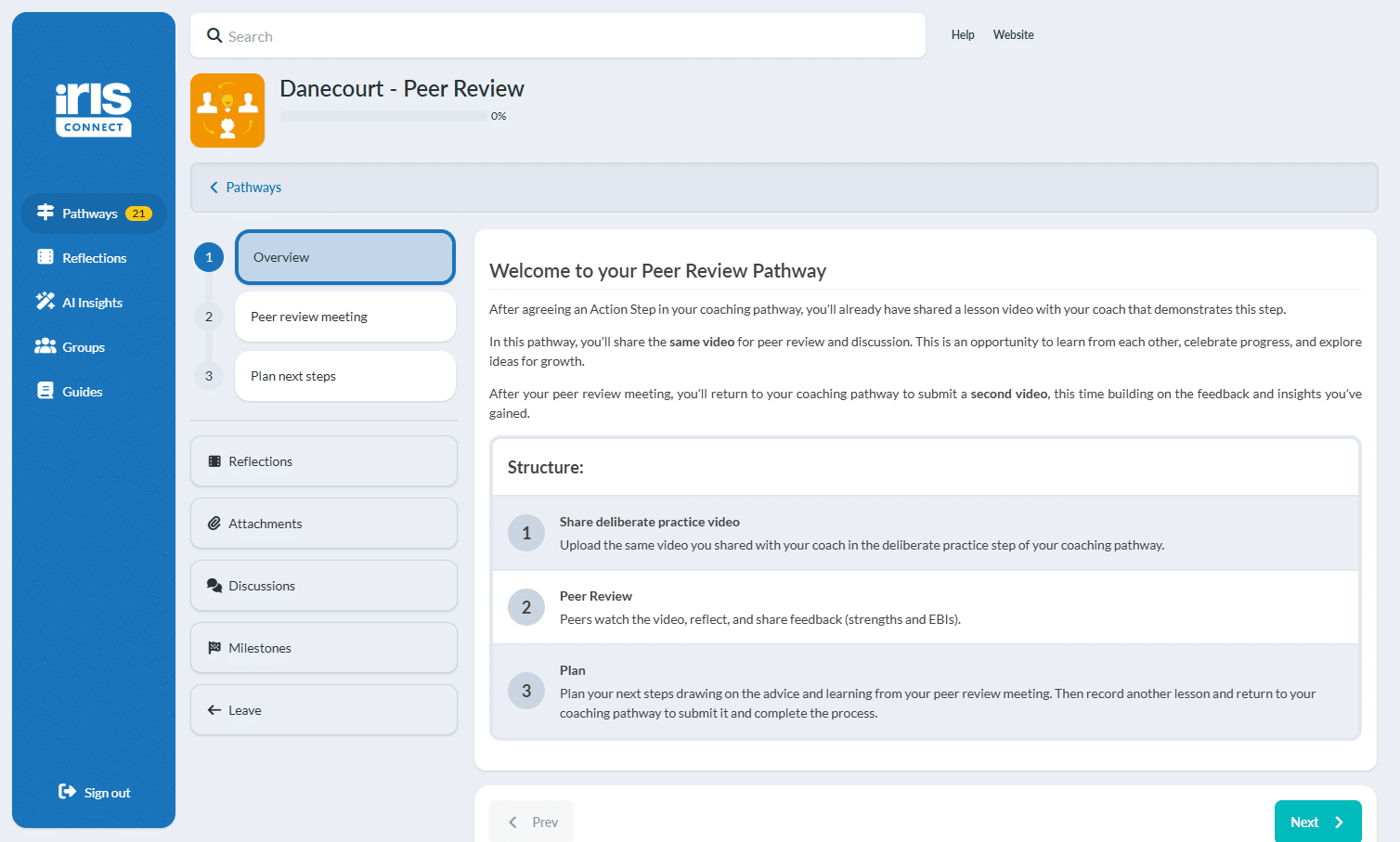
Danecourt School’s bespoke peer review Pathway
"We've got therapists, HLTAs, ECTs, right up to the person who's been teaching in special thirty years..."
Lou Elliott, Assistant Headteacher, Danecourt School
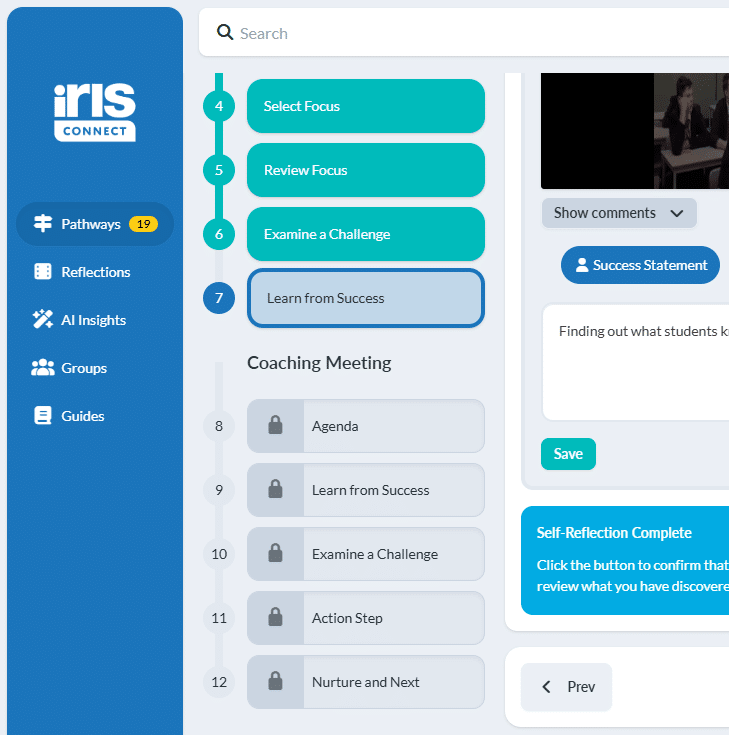
The coaching meeting steps inside Danecourt’s Pathway
The Balance: Where Accountability Lives
Agency does not mean leaders step back and hope. At the end of each two-term cycle sits a learning walk, the point where leaders ask one question.
“The accountability, the question, comes at the end: okay, well, has that actually transferred into your practice?”
— Matt Smith, Deputy Headteacher, Danecourt School
Just as important, leaders are in and out of classrooms all the time, so they already know where things stand without waiting for a formal date. The model also flexes for different people: early career teachers and HLTAs, or anyone not yet ready to be coached, receive a more direct, mentoring style of support, so no one is left adrift. Here, accountability supports ownership rather than competing with it. The learning walk is what lets leaders trust the freedom they have given.
The Impact: From Compliance to Conviction
The early evidence has surprised even the leaders who built the model. Despite knowing that filming yourself can feel uncomfortable, the response from teachers has been more positive than expected.
“100% of the 17 teachers said that it was useful for their CPD.”
— Lou Elliott, Assistant Headteacher, Danecourt School
To understand the change properly, Danecourt is now running an action research project with the University of Greenwich, examining how the approach shifts teacher belief and ownership across different cohorts. The deeper proof, though, is in the feeling Matt Smith wants every coaching conversation to leave behind. This is what ‘done with’ sounds like.
Grounded in Research
The teacher in the driving seat: rather than being told what to fix, the teacher studies their own practice on video and refines it over many attempts until it embeds. Findings from the Greenwich research to follow.
What’s Next: Reaching the Whole Workforce
With teachers and the therapy team established on the two routes, Danecourt’s attention is turning to its largest group of all: around 120 teaching assistants, the hardest to reach because of the hours they work. Short, regular “snapshot” training sessions are already running. In time, the school hopes to build a library of strong practice captured in its own classrooms, shared through “film club” conversations, something Matt Smith is candid the school has not reached yet.
It is the same conviction that has driven the whole journey: nothing beats seeing real practice, with your own children, in your own context, and then talking about it together.

Advice for Other Schools: Be Honest About the Journey
Danecourt clearly states that this is a journey, not a finished destination. The hardest part has been the human one: helping every member of staff become comfortable being filmed, and shifting long-held beliefs about what monitoring is for.
"Some teachers have jumped in with both feet. It's about continuing to embed it and seeing what the impact is over time, because otherwise, what's the point?"
Matt Smith, Deputy Headteacher, Danecourt School
Could This Work in Your School?
Whether you lead a special school or a mainstream one, IRIS Connect can help you build a coaching culture that gives teachers ownership without losing accountability, with bespoke routes shaped around how your school actually works.