

CPD for Teachers:
What Works and How to Deliver It
- Last Updated: 27th August, 2026
- Shawn Edmondson
Summary
The most important school-related factor influencing student achievement is teacher quality (Coe, 2014). Being well aware of this, most schools make sustained efforts to provide effective professional development opportunities for their teachers. However, research shows that while continuous professional development (CPD) of teachers can be effective, it’s often not.
Contents
Introduction
In a comprehensive report released by the Education Endowment Foundation (EEF) in 2021, 14 mechanisms were identified that lead to effective CPD design, yet most professional development only covers a few of these.
The consequences show up in how teachers experience CPD. The Teacher Development Trust’s national CPD Landscape survey (2025) found that over a third (39%) of teachers and leaders said their CPD had not clearly improved their ability to do their job, and nearly one in five spent less than a single day on formal CPD across the year. There’s a perception gap as well: 67% of senior leaders say CPD improved their ability to perform their role, compared with just 54% of classroom teachers.
The prize for getting it right, though, is substantial. A rapid review and meta-analysis by the Education Policy Institute and Ambition Institute found that high-quality professional development has the potential to close most of the gap between novice and experienced teachers, with an effect on pupil outcomes comparable to that of a teacher gaining a decade of classroom experience. The same review found this impact exceeds that of other school-level interventions, including performance-related pay and lengthening the school day.
The good news is that teachers remain firmly invested in their own development. The TDT survey also found that seven in ten teachers and leaders said CPD addressing workload and wellbeing would increase their likelihood of staying in the profession, with those intending to stay citing personalised CPD, protected time, and collaborative learning as key motivators. Professional development done well isn’t just a quality lever; it’s a retention lever.
Whether you’re new in your role as CPD lead or would like to further expand your knowledge to provide better learning opportunities for your staff, below you will find answers to the most common questions around continuing professional development, learn what the research says makes teacher professional learning and development effective, and find suggestions for putting those into practice.
1. Getting Started With CPD
The Importance of CPD of Teachers
Supporting high-quality teaching is pivotal in improving pupil outcomes and can narrow the disadvantage gap (EEF, 2021). High-quality teaching, however, is something which cannot be achieved overnight. It requires a continuous process of development over the course of a teacher’s career.
CPD
When we think of teachers’ continuing professional development (CPD), it’s often one-off training courses that first spring to mind. These training courses are mostly about providing a theory snapshot of something specific but if they’re not subject or context specific, can sometimes feel quite generic and offer little guidance on implementing the new information in the classroom.
Professional Learning and Development
Development, on the other hand, is informal and has a wider application. It’s about developing a teacher’s ability to transfer and adapt what they’ve learned in training to their classroom practice. It’s an iterative process of collaborative reflection, enabling teachers to progress from basic know-how to a more advanced understanding and being able to adapt their newly learned skills, knowledge or teaching strategies in a way that best meets the needs of their pupils.
Both training and development have key roles to play in effective CPD. Let’s take a look at an example:
Susie has been teaching for five years. She’s heard about a new teaching strategy that she wants to learn more about, so she applies to go on a day course. During the course, she learns all about the strategy and the theories behind it. At this point, Susie has taken part in the training. It’s not until she is back in her classroom applying the strategy with her own children, analysing the results, tweaking her technique, improving her practice and sharing with others that she’s taking part in continuing professional development.
Standalone training sessions, therefore, can be part of a CPD plan but in order to be effective, it needs to encompass much more than that. We’ll look at this in more detail in the section ‘The Building Blocks of Effective Professional Development’. Other popular CPD types for teachers include research, self-reflection and lesson observation, lesson study and feedback, coaching and mentoring.
When we first started working with schools, over a decade ago, we would routinely encounter schools that had experienced disappointing outcomes of their professional learning endeavours. Poor design had led to repeated failures and frustrated school leaders had resorted to pulling harder on the levers of policy and monitoring to “drive change”. Teachers, in turn, had become entrenched in cynical attitudes towards “yet another initiative” and pushed back on crude monitoring. These two responses often fed upon one another, creating a toxic learning culture where no progress was possible.
It’s important to acknowledge the strides made in schools since then. The last few years have seen a sea change in schools’ approaches to CPD. They’ve largely moved away from ineffective, summative observation. There is broad recognition of CPD as a process requiring ongoing support and skill development outside of designated INSET time, and the focus of professional development initiatives is largely evidence-informed.
Schools that manage to successfully provide their teachers with effective career-long development opportunities not only help their teachers to become the best teachers they can be and increase the quality of teaching, but ultimately improve pupils’ learning success and therefore their chances for a promising career.
CPD for Trainee Teachers
In the beginning of a teacher’s career, CPD is especially important. With little previous teaching experience, trainee teachers are faced with many practical challenges, like learning how to run a classroom or structure a lesson, as well as overcoming mental hurdles like imposter syndrome and building up their confidence.
The Initial Teacher Training and Early Career Framework (ITTECF), which underpins all trainee and early career teacher training from September 2025, acknowledges the need for better support in those crucial first years and keeps mentoring firmly in the spotlight. By combining what were previously separate frameworks, it gives new teachers a single, evidence-based development journey of three or more years, from initial training through the Early Career Teacher Entitlement, with structured mentoring and dedicated time off timetable built in. Part of this support involves observing, deconstructing and critiquing examples of teaching. The use of video recording technology like IRIS Connect proves to be a powerful tool for this. It allows trainees, early career teachers and their mentors to analyse video lessons in their own time, removing the barriers of time and distance. The result is contextualised, more granular feedback that helps these teachers accelerate their learning.
This approach is trusted right across the ITT landscape. IRIS Connect supports providers of every shape and size: national programmes like Teach First, one of the country’s largest teacher training providers and a partner since 2021, with trainees across both years of the Training Programme using the platform; multi-academy trust providers such as United Teaching; and regional SCITTs like Nottinghamshire Torch SCITT, giving trainees the same quality of observation, reflection, and feedback wherever their placement happens to be.
“In an average year, providing instructional coaching regularly and responsively is hard, particularly when those leading teacher training aren’t based in the same school. Teachers are busy and have complicated timetables. Colleagues supporting them cannot watch every lesson, or even every difficult lesson. Sometimes there can be lengthy gaps between these instructional coaching cycles and progress slows down. Using IRIS Connect means we can remove some of these logistical barriers.”
– Amy Mitchell, former Director of Programme Innovation and Insights at Teach First
Benefits of CPD
Teachers learn naturally over the course of a career. However, learning from experience alone will ultimately limit development. Continuing professional development enables them to become the best teachers they can be and allows their pupils to achieve better learning outcomes.
- It ensures teachers keep pace with the current standards of others working in education.
- It keeps their knowledge and skills current so they can deliver high-quality teaching and impact positively on pupil outcomes.
- It makes sure that they become more effective in the workplace. This helps them to advance in their career and move into new positions where they can lead, manage, influence, coach and mentor others.
- It opens them up to new possibilities, new knowledge and new skills.
- It leads to increased confidence in themselves, others and the profession as a whole.
CPD for teachers is also very useful at:
- Reminding them of their achievements and how far they’ve progressed.
- Directing their careers and helping them keep an eye on their goals.
- Uncovering gaps in their skills and capabilities.
- Opening up further development needs.
Use IRIS Connect to support your current CPD activities and elevate your teaching and learning quality:
How to Create a Professional Development Plan for Teachers
In their guest blog for IRIS Connect, Zoe and Mark Enser, co-authors of ‘The CPD Curriculum: Creating conditions for growth‘ suggest three steps for school leaders to take in order to create a plan that utilises CPD to best effect:
First, diagnose before you design. Look carefully at what the real issues are in your school, department, or classroom: the barriers your pupils face, what you want them to be able to do, what staff already know that you can build on, and, most importantly, what success will look like once the change has been implemented.
Second, design at a granular level and treat your staff like learners. Effective change is a slow process, so the steps and stages need deciding deliberately, building on prior knowledge and managing cognitive load just as you would with pupils. Teachers need to understand the theory behind a change, but they also need to see abstract ideas made concrete and have the chance to explore what they look like in their own context.
Third, build in regular feedback loops. Check progress towards the goal, watch for deviation, and decide next steps as part of the natural rhythm of the school year. As the Ensers put it: “The more granular our approach, the easier it is to isolate the steps taken and know what the next ones may be, and the more bespoke CPD will feel.”
Read the full article: ‘Why A CPD Curriculum Matters & How To Build One’
How to Eengage Teachers in Professional Development
“Being a teacher means wanting, more than anything, to make a difference in the learning lives of students. It means being willing to make, everyday, huge amounts of emotional as well as intellectual investment in the service of those who don’t necessarily want to learn, to learn what you are teaching or to learn from you.” – Christopher Day
Most teachers choose their profession for a reason, even if sometimes that initial motivation might fade a bit to the background as the years progress. Appealing to that core motivation when it comes to CPD, promoting it as a tool to help them be the best teacher they can be, can go a long way towards reaching your schools’ CPD goals.
Research has shown that mid-career teachers participate in marginally less CPD than early career teachers and report significantly greater barriers to engaging in CPD, which is in line with the competing demands of their work and personal lives.
One of the biggest barriers, however, is the lack of relevant CPD opportunities. Mid-career teachers are likely to feel confident with the basics of classroom management and teaching practice and may thus require more specialised CPD opportunities that allow them to further develop their expertise. They tend to judge the CPD that they engage in to be less effective than colleagues in earlier stages of their careers. (Müller et al., Chartered College of Teaching, 2021, drawing on OECD TALIS 2018)
If you’re struggling to motivate your teachers to participate in professional development opportunities, ensure you’ve got the basics covered. Is the information presented relevant for your teachers’ career stages and credible (research-based and from experts)? If it’s not, begin with determining why that’s the case and change it. If it is, ask yourself if your teachers are aware of that and know the potential impact it can have. You may also find that your teachers disagree with the presented information, in which case this should be a topic of debate and conversation.
Having this type of conversation leads to a second important point in motivating teachers to participate in professional development – your school culture. Is there an open dialogue between staff about teaching and learning? Do you give your teachers enough autonomy or does your school mostly have a top-down approach?
Involving your teachers early on in your school’s goal setting for CPD initiatives, as outlined in the CPD curriculum section above, will give them a greater sense of ownership. Ensuring they have time to work on their development, allowing them to team up so they can motivate and learn from each other, recognising their achievements and celebrating excellence are further ways that will help to get your teachers engaged in professional development.
2. Teacher-Led CPD
Why Teachers Should Own Their CPD
Teachers cannot be developed (passively). They develop (actively) (Day, 1999). It is vital, therefore, that they are centrally involved in decisions concerning the direction and processes of their own learning.
According to research undertaken by National Foundation for Educational Research (NFER) and the Teacher Development Trust in 2020, teachers’ autonomy and their perceived influence over their professional development goal setting is the area most associated with higher job satisfaction and a greater intention to stay in teaching.
Ownership matters for expertise, not just satisfaction. Dr Chris Baker, who leads Teaching and Learning and Professional Development across the Cabot Learning Federation, warns that when development is done to teachers rather than by them, engagement quietly declines and teachers slip into the mindset of “I only learn things when they’re given to me.” Over time, the deep thinking that builds genuine expertise erodes with it.
That doesn’t mean abandoning consistency. The goal, Baker argues, is flexibility within structure: a shared model of what excellence looks like, with teachers trusted to use their professional judgment on how to get there. This is the balance IRIS Connect Pathways are built to hold: a structured, evidence-based development sequence within which each teacher sets their own Objectives, records and reflects on their own practice, and decides how a technique should work for their pupils.
Relevance in CPD
Each teacher has different levels of experience, different priorities they want to focus on, and different ways they like to learn. It can’t be presumed that one style of professional learning will fit all. This is why CPD must be relevant to the specific teaching context. For instance, if you’re teaching secondary students, your CPD should be tailored to that environment. Engaging in training designed for primary education might not be applicable unless there’s a transition in your teaching focus.
Apply New Learning Consistently
CPD is only effective when consistently applied in the classroom. Learning new strategies or techniques is beneficial only if they become part of your daily teaching practice. Record and review each CPD activity, considering how it can enhance your teaching and positively impact students and peers. The goal is to integrate new learning until it becomes a habitual part of your approach.
Philippa Cordingley (Chief Executive of CUREE) has in the past spoken about how it would be helpful for SLT to view staff like they would a class, suggesting that CPD Leads need to plan and structure CPD training for teachers in the same way they would a lesson.
The difference is that Philippa is not concerned with viewing staff like a class in order for the CPD Lead to feel confident in delivering a training session. Instead, her message is that CPD Leads need to consider what it is that every individual member of staff needs, just as a teacher uses differentiation in the classroom. In the best classrooms, we see children as active contributors to the learning process and the same should be true of professional learning.
Professional development activities should:
- Be designed around individual teachers’ existing experience, knowledge and needs
- Be relevant to the context and day-to-day experiences of teachers and their schools
What Kind of Professional Development Do Teachers Want?
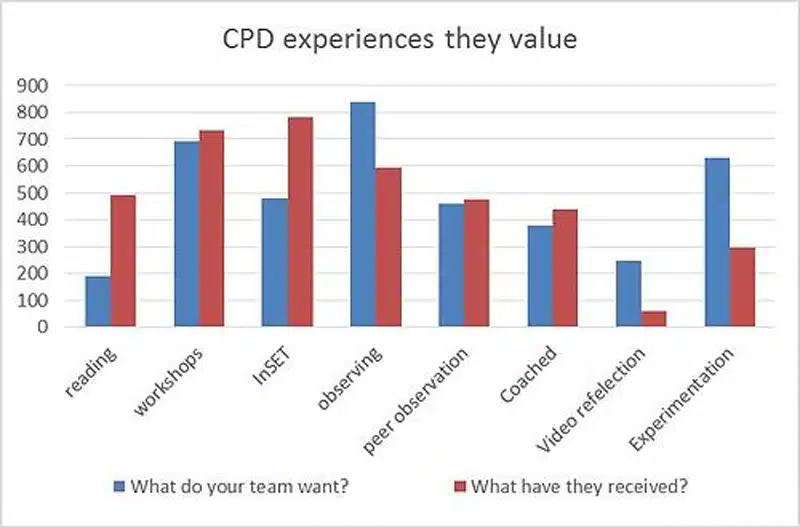
When we asked 1,000 teachers what professional development activities they would prioritise if they were in control of their own CPD. They gave us some interesting insight.
Teachers really valued collaborative and personalised classroom-based CPD. In fact, they find these professional development activities even more useful than being sent off site to courses or receiving one-off INSET days.
The image below shows those teachers’ CPD preferences.

“I would prioritise a system that staff trusted to be fair, supportive and provide real and constructive feedback to help improve teaching practice.”
Teachers also expressed a lot of interest in experimenting with different teaching practices. However, less than half of those who said that they highly value the ability to experiment with their professional learning claimed they are actually given the opportunity to.
“The whole reason for CPD is to develop the staff who will then bring new and fresh ideas to their teaching to be then able to get the outstanding lessons that people want.
I would prioritise more in-house training to provide ideas about different teaching styles and activities.”
Over 80% of the teachers surveyed said they value classroom observing as a professional development experience. This includes being observed by a peer, a coach or a mentor, as well as observing the teaching of others.
“I would prioritise the opportunity to observe and learn from each other.”
A number of teachers said that if it was up to them, they would prioritise watching other teachers teach in classroom observations, and would value the chance to observe teachers with particular expertise in different areas.
It was also suggested that video could be used to share this expertise and make it easier for teachers to observe each other by relieving the costs of lesson cover and the struggles of timetabling issues. However, only a quarter of teachers who said that they highly value video reflection claimed they have been able to use it for their continuous professional development.
Teachers want CPD that is collaborative, classroom-based, and built on trusted, constructive reflection. Discover how IRIS Connect’s Guided Reflection puts that within every teacher’s reach.
3. The Building Blocks of Effective CPD
What Does Good Teacher CPD Look Like?
In 2021 the Education Endowment Foundation (EEF) published comprehensive guidance on what makes professional development effective, based on a meta-analysis of over 104 educational research papers. The report highlights the importance of focusing on key mechanisms that look beyond programmes’ surface features just like a wise astronaut would be more interested in a rocket’s engines and computers than its appearance. (Read our full article here)
To get your professional development endeavour to lift off, you need to look beyond the headlines of “lesson study” or “instructional coaching” and attend to how these programmes expose teachers to effective learning experiences in order to successfully improve the quality of teaching and its impact on pupils.
These mechanisms are ‘empirically-evidenced general principles about how people learn and change their practice.’ Split into four different groups, 14 mechanisms were identified:
A) Building Knowledge
- Managing cognitive load
- Revisiting prior learning
Building Knowledge Top Tips:
- Discussing new ideas in the abstract places a heavy load on working memory. Video models bring new concepts to life, and video drawn from real classrooms, adapted to different contexts, is more powerful than a single “exemplar” that implies there is only one correct way to apply an idea. IRIS Connect’s Teaching Techniques library pairs bite-size, research-informed guidance with video models of each technique in practice, so teachers build a clear mental model of what good looks like before they try it themselves.
- To guard against misunderstanding or misapplying a new idea (what the research calls ‘fatal mutations’), give teachers space for professional dialogue around what they have seen. Within Pathways, teachers can record their own practice, share it securely, and add time-stamped annotations, turning video into the focus of a genuine professional conversation with a coach or colleague. AI Insights supports this by analysing a lesson at the click of a button, surfacing patterns and moments worth discussing while keeping the thinking with the teacher.
- Revisiting prior learning matters just as much as introducing new ideas. Because Pathways guide teachers step-by-step and keep every reflection, comment, and resource in one place, teachers can return to earlier learning, revisit their goals, and build on what came before rather than starting from scratch each time.
B) Motivating Teachers
- Setting and agreeing on goals
- Presenting information from a credible source
- Providing affirmation and reinforcement after progress
Motivating Teachers Top Tips
Get your teachers involved in identifying and setting their own development goals. These goals should be S.M.A.R.T. (Specific, Measurable, Achievable, Relevant, and Time-bound).
- Give teachers a place to record those goals and see their progress over time. In Pathways, each teacher works towards their own goals within a structured framework, with every step, reflection, and piece of evidence captured in one private space. That visible sense of progress is motivating in itself, and it gives leaders and coaches a clear picture of how each teacher is developing.
- Simple rewards and recognition have their place, but by also having teachers authentically share their knowledge, learnings, and expertise, not only are they being celebrated, they’re also sharing valuable information with others who can benefit. How about creating a library of good practice where teachers can share their knowledge?
C) Developing Teaching Technique
- Instructing teachers on how to perform a technique
- Arranging social support
- Modelling the technique
- Monitoring and providing feedback
- Rehearsing the technique
Developing Teaching Technique Top Tips
- Make use of IRIS Connect’s Teaching Techniques library, which is a collection of research-informed technique guides, organised into focus areas that cover the fundamentals of effective teaching. Each technique has a bite-size summary of the underlying evidence, video models showing the technique used in class, and cognitive rehearsal activities that help teachers prepare to use it themselves. Because every school is different, they can be adapted to their own context or their own resources can be added to reflect the priorities.
- The techniques become most valuable when they become part of a teacher’s development journey. While progressing through a Pathway, teachers move through a structured flow from understanding the evidence, to seeing the technique modelled, to rehearsing it, to applying it in their own lessons and reflecting on the impact. The technique is no longer something teachers have to go and find; it is built into the next step of their development.
D) Embedding Practice
- Providing prompts and cues
- Prompting action planning
- Encouraging monitoring
- Prompting context-specific repetition
Embedding Practice Top Tips:
- Encouraging the teacher to rehearse and practise a new technique in an iterative cycle of reflection and feedback is an effective way of bridging the gap between knowing and doing.
- Provide teachers with prompts, cues, and reminders to keep them consistently executing their action plan. Pathways do this by design, breaking development into clear steps and always keeping the next action in front of the teacher.
- Ensure teachers have protected time to act on their plan and the prompts provided.
- Establish a method whereby teachers can monitor and record their own progress towards a specific goal. For instance, teachers can record their teaching on video, reflect on what they see, and document their observations against a clear objective, building an evidence-based picture of how their practice is developing over time. On IRIS Connect, Pathways and Objectives bring this together in one place, so progress is easy to capture and easy to see.
- Assign your teacher a coach or mentor that will help them to hold themselves accountable and continue to make progress.
- Building a small group with other teachers for them to be part of is another effective, encouraging and motivating way to hold themselves accountable and push each other to excellence.
Book a demo to find out more about how IRIS Connect can support you in providing effective CPD for your staff.
4. Making CPD Work When Time and Capacity Are Tight
Ask any school leader what gets in the way of great professional development and the answer is rarely a lack of will. It’s time and capacity. Teachers struggle to find space in the week to engage in meaningful development, coaches can only be in one classroom at a time, and every in-person observation carries a cost in cover and release time. Expertise is often unevenly spread too, with the colleague a teacher would most benefit from learning from working in a different department, or a different school entirely.
For a long time, the assumption was that there was no way around this: that professional learning done remotely, or through video rather than in person, must be a lesser substitute. The evidence says otherwise. Two independent rapid evidence assessments, one from the University of Birmingham’s Department of Teacher Education and one from the EEF alongside Durham University, examined remote and blended professional development and concluded that there is little difference in effectiveness compared with traditional methods. Both highlighted the particular value of video technology, “as it has the potential to bring classroom interactions into a teacher education space” without the expense of face-to-face observations (i.e. around release time) and the reliance on memory – which will be most fresh immediately after the teaching and increasingly distant as time passes.
That last point matters more than it first appears. Traditional observation feedback depends on what the observer happened to notice and can remember by the time the conversation takes place. Video removes that dependency: teacher and coach can revisit the actual lesson, together, whenever their timetables allow.
AI is now extending this further. Where a recorded lesson once still needed someone with the time to watch and analyse it, tools like AI Insights can analyse a lesson in seconds, surfacing patterns, questioning habits, and moments worth exploring, so teachers get timely, developmental feedback without waiting for a scheduled observation, and coaching conversations start from evidence rather than admin.
Schools are already seeing the difference. At Langley Heritage Primary, early career teacher Elina used AI Insights to review her own questioning technique: the analysis showed her every question she had asked and suggested a concrete next step, to build in more follow-up questions. She applied it in her very next lessons and saw the difference in pupil engagement straight away. That’s the kind of tight, self-directed development loop that simply isn’t possible when feedback depends on someone being free to sit at the back of the room. Read more about how schools are using AI to transform teacher development >
None of this replaces the human elements of professional development. Coaching conversations, peer support, and expert judgement remain at the heart of effective CPD. What video and AI do is remove the logistical barriers around them, so that development is limited by ambition, not by the timetable.
5. How to Assess the Quality of Your CPD Initiatives
When determining the quality of a CPD initiative, the main question to ask yourself is what kind of impact it actually has on your teachers’ practice. No matter how inspiring a CPD intervention may be, in the end what counts is the actual change and application in the classroom.
Thinking back to the building blocks of effective professional development as outlined above, does your CPD tick all the boxes?
- Does it build teachers’ knowledge by presenting them with new information (e.g. about instructional practices)
- Does it motivate teachers to act upon the new knowledge they have gained?
- Does it provide teachers with the teaching techniques they require to improve practice?
- Are teachers sufficiently supported to apply what they’ve learned in the classroom?
To enable effective career-long learning, CPD needs to be first and foremost relevant for your teachers’ career stage, experience and interest. Involving your teachers in the process as early as possible and giving them the autonomy to decide for themselves what they’d like to focus on will get their buy-in and contribute to higher job satisfaction. A well thought-through CPD curriculum ensures you’re reaching your overall school improvement goals, and measuring any planned CPD intervention against the 14 mechanisms outlined by the EEF, will ensure it actually has an impact on your teachers development and contributes to better learning outcomes for your pupils.
Effective CPD doesn’t happen by accident. It happens when schools build professional development around the mechanisms the evidence points to: building knowledge, motivating teachers, developing technique, and embedding practice, and give teachers the tools and time to make development part of everyday teaching. That’s exactly what IRIS Connect is designed to support, and schools using it see the difference where it matters most: in the classroom.
“The impact of IRIS Connect on our pupil outcomes has been phenomenal. Since 2019-2023 we have seen a 20% increase in reading and writing at the end of key stage 2.” – Kerry Burns, Deputy Headteacher, Woodside Primary School
Interested to find out more?
If you’d like to find out more about IRIS Connect and how our solution can help you to get the most out of your classroom observations and provide high qualitative PD for your teachers, get in touch!
Sources
- Coe, R., Aloisi, C., Higgins, S., and Elliot Major, L. (2014). What Makes Great Teaching? Review of the Underpinning Research. Sutton Trust.
- Education Endowment Foundation, 2021 – “Effective Professional Development Guidance Report”
- Enser, Z. and Enser, M. (2021). The CPD Curriculum: Creating Conditions for Growth. Crown House Publishing.
- Lisa-Maria Muller – Chartered College of Teaching, UK, Josephine Booth, Michael Coldwell, Emily Perry – Sheffield Hallam University, UK and James Zuccollo, Education Policy Institute, UK, 2021 – “Continuous professional development and career progression in mid-career teachers”
- NFER & Teacher Development Trust, 2020 – “Teacher autonomy: how does it relate to job satisfaction and retention?”
- EEF & Durham University, 2020 – “Rapid Evidence Assessment: Remote Professional Development”
- Baker, C. (2026). Protecting Agency in the Pursuit of Consistency. Talk delivered at CPD Exchange London, IRIS Connect.
- Day, C. (1999). Developing Teachers: The Challenges of Lifelong Learning. Falmer Press.
- Department for Education (2024). Initial Teacher Training and Early Career Framework (ITTECF). GOV.UK.
- Perry, T. et al. (2021). Remote and Blended Teacher Education: A Rapid Review. Education Sciences, 11(8), 453.
- Fletcher-Wood, H. and Zuccollo, J. (2020). The Effects of High-Quality Professional Development on Teachers and Students: A Rapid Review and Meta-Analysis. Education Policy Institute with Ambition Institute, commissioned by the Wellcome Trust.
- Bart Crisp, Warwick Journal of Education, 10 WJETT 2017, vol 1 ‘An Interview with Philippa Cordingley (CUREE)’ (2017).
- Teacher Development Trust (2025). Teacher Development: The CPD Landscape in 2025. Survey conducted by YouGov.
Get blog notifications
Keep up to date with our latest professional learning blogs.
By clicking Subscribe you consent to us contacting you regarding our products and services, as well as other content that may be of interest to you. You also consent to us storing your personal data to provide you with the content you are requesting. You can unsubscribe at any time. To find out more about how we manage your data, please review our Privacy Policy.