

All Change: Reflecting on the new OfSTED toolkit
- Last updated: 1st October, 2026
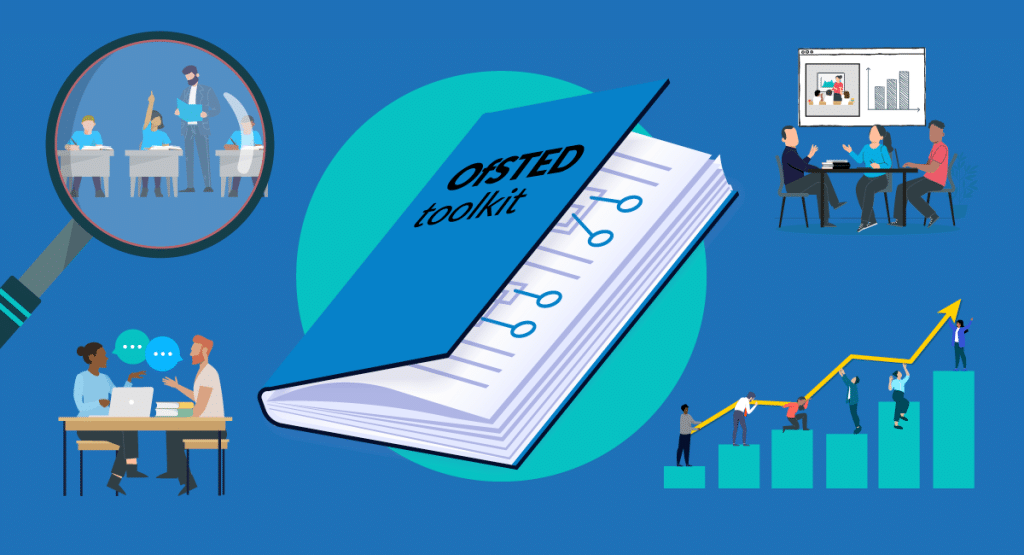
On 5 November 2025, the government released the new school inspection toolkit. As with any new framework, it takes time to reflect on and digest the implications across its nine key areas of focus.
A renewed emphasis on professional learning
One aspect that stands out immediately is the renewed emphasis on professional learning. Where the previous framework made only limited reference to it, the new toolkit, if not overflowing, makes clear that it will be a central theme in school inspection. This is entirely appropriate. The evidence is unambiguous: high quality professional learning is the most effective lever available to school leaders for improving learning outcomes.
The shift is not only one of emphasis. There has also been a deliberate change in language. Inspectors will now look for evidence of “high quality, evidence informed, sustained and coherent programmes of professional learning.” Previously the focus was on professional development. This distinction may appear subtle, yet it reflects a long-running debate about how best to support teacher growth. Development is often associated with training particular techniques and transmitting knowledge, while learning is favoured by those who see teacher growth as a collaborative, ongoing process centred on reflection and dialogue and responsive to culture and context.
This new emphasis appears throughout the sections of the document that relate to teacher growth. Where earlier guidance focused on promoting pedagogical and subject pedagogical knowledge, the new toolkit highlights the need for programmes that aim to build teacher expertise.
From technical training to professional expertise
Expertise is defined clearly as the knowledge, skill and judgement of teachers. The recognition that teaching skilfully matters is another welcome change in emphasis. In recent years, professional development in England has often leaned heavily toward the technical, with behavioural rehearsal of defined techniques becoming the dominant route to improvement. I.e. PD is about training teachers to do the right things. Yet an action is only truly right when it is taken at the right moment and for the right reason. This calls for far more than technical proficiency. It requires professional noticing, interpretation and sound judgement, capacities that rehearsal by itself cannot produce.
The evidence is clear, truly skilful teaching develops over time through sustained reflection on experience. Such reflection can be supported through purposeful professional dialogue and must be, as the document notes, “rooted in a culture of purposeful collaboration”.
This shift toward collaborative and collective learning is an important recognition that teaching is not a stage profession such as music or sport. In those fields, long hours of practice typically precede performance, feedback loops are immediate, and improvement can be measured against a clear model. Teaching is different. Opportunities for development are, however well prioritised, comparatively rare. Feedback is often delayed and ambiguous, and the work itself is shaped by dynamic classroom contexts. If we want teachers to make “highly effective choices”, or to form well founded habits that are sensitive to context, they need more than the limited one to one coaching time schools can realistically provide. They need collaborative professional learning woven into the school day, in order to share ideas, challenge assumptions and support one another’s practice.
Rising expectations and the limits of school-led CPD
The Teacher Development Trust (TDT) CPD Landscape Report 2025 revealed that fewer than half of teachers found their professional development relevant to their day-to-day practice. This persistent mismatch between need and capacity has long been a challenge for school leaders. Now, with the new toolkit requiring professional learning to build expertise across multiple layers — balancing whole-school improvement priorities with those of subjects, teams, phases, and individual teachers — the pressure is intensifying.
This raises an important question: at what point does it become unfeasible for individual schools or even trusts to design and sustain such programmes alone? Many schools that currently feel confident in their CPD provision may find themselves struggling to meet the new expectations.
Building coherent systems for professional learning
Perhaps it is time to move from delivering learning to building flexible, scalable systems of learning. By bringing all professional learning activity together within a single platform, teachers can engage in reflective and coaching cycles tailored to their specific needs, middle leaders can coordinate collaborative workflows aligned to team goals, and senior leaders can address whole-school priorities through centralised modules. With one integrated system, every professional learning activity has a common point of reference, reporting becomes seamless, and expertise-driven development can be designed, shared, and accessed instantly.
There is no denying that this renewed emphasis on professional learning presents significant challenges — but they are challenges worth meeting. With the right focus, support, and culture, the potential impact is enormous. At IRIS Connect, we’ve been building and refining tools to help schools meet exactly this challenge for over 17 years. If you’d like to explore how we’ve moved far beyond video to create comprehensive systems for professional growth, read on.
How IRIS Connect has evolved to change the way schools develop teachers
The first thing to know is that while one size certainly does not fit all, most schools share a set of broad requirements regarding their professional learning. We use this to create personalised learning experiences, but through adaptive templates saving schools time and money.
The first step is to decide how you want teachers to engage by selecting a pathway type from our library of templates. You may want teachers to reflect individually, work with a coach or participate in a collaborative departmental process for example.

The next step is to consider the learning interactions that should form the cycle. For example, a teacher might begin by reviewing their practice with the assistance of AI, then read relevant theory, take part in a coaching conversation, engage in deliberate practice and share their progress with colleagues. We can build cycles that include any or all of these interactions.

Finally, you can choose the tools and resources teachers will draw upon. Options include a library of more than one hundred expert-built teaching strategies with video examples and preparation activities, a collection of 150+ Teaching WalkThrus or any resources a school or trust wishes to make available.

With minimal preparation, this creates adaptive and responsive professional learning opportunities that incorporate the mechanisms that matter. Teachers will see a subset of PL cycles on their IRIS Connect homepage based on their role or individual needs so they can engage with what matters to them, their department and their school.
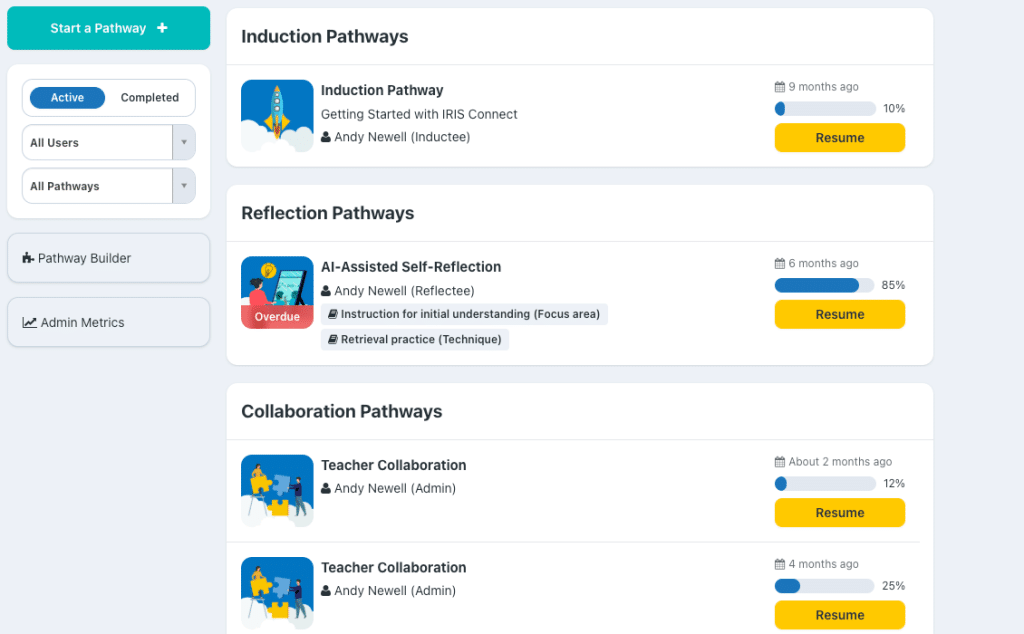
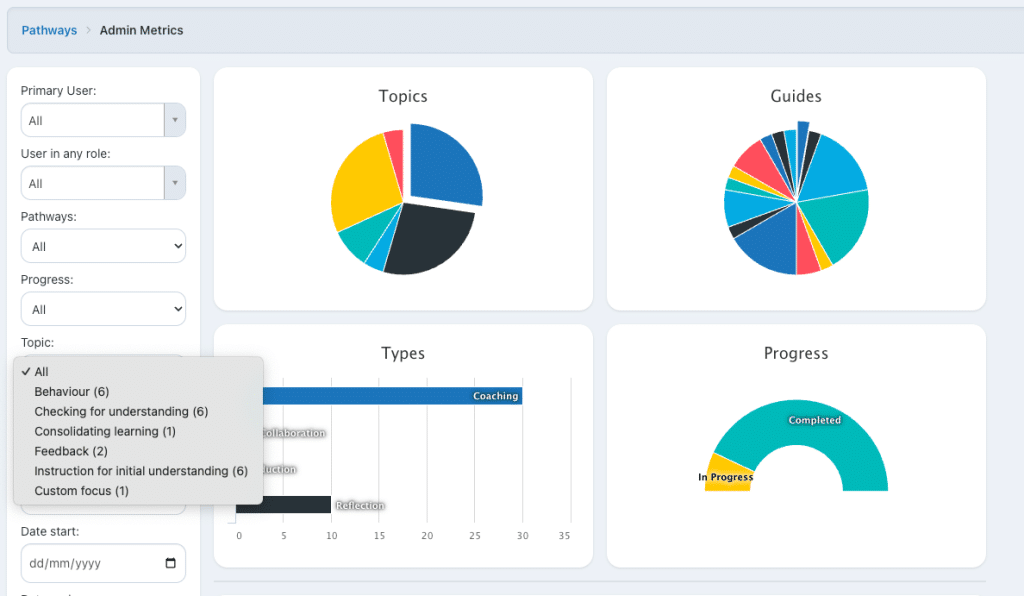
Perhaps the most helpful aspect is that, wherever learning takes place, progress and insights flow back to a central dashboard. This allows leaders to monitor progress, refine programmes over time and be well prepared the next time the inspector calls.
Interested to find out more? Click here to request a free demonstration.
About the Author
Andy is the founder of IRIS Connect and a regular speaker at professional learning events. He is passionate about bridging the gap between what the research shows about effective professional development and the practical delivery of impactful learning interactions. His journey began at the University of Sussex with groundbreaking work on the use of video in initial teacher training and culminated in the development of a web based platform to enhance teachers’ reflection and collaboration. Since founding the company Andy has worked around the world supporting effective teacher development, and has been involved in many inspiring educational projects and research.

Get blog notifications
Keep up to date with our latest professional learning blogs.
By clicking Subscribe you consent to us contacting you regarding our products and services, as well as other content that may be of interest to you. You also consent to us storing your personal data to provide you with the content you are requesting. You can unsubscribe at any time. To find out more about how we manage your data, please review our Privacy Policy.