

Rethinking Coaching: Culture, Purpose, and Practice in Schools
- Last updated: 26th February, 2026
Please note – This is a write-up of Sam Gibbs talk at Coach. Empower. Retain: Conference, click above to watch the video of her presentation.
Introduction: The Coaching Conundrum
At the recent “Coach. Empower. Retain.” conference hosted by IRIS Connect in Manchester, Sam Gibbs, Director of Professional Development at Greater Manchester Education Trust (GMET), delivered a compelling presentation that charted the evolution of instructional coaching across the trust. With clarity, candour, and a research-informed approach, Sam Gibbs outlined both the promise and the pitfalls of coaching in today’s schools.
Sam Gibbs’ central message was one of rethinking: to avoid coaching becoming a disconnected initiative, it must be rooted in a shared culture, guided by purpose, and implemented through responsive, empowering practice.
Coaching Models: From Frameworks to Fluidity
Our Early Approach
In the early years of my role, I was eager to introduce structured coaching. We adopted variations of models like the Bambrick-Santoyo “Six Steps”, which offered clarity and sequence. These models were helpful in getting us started—they provided a shared language and a clear routine for our coaches.
But over time, I began to see limitations. Coaches told me it felt too scripted, too rigid. They wanted to be more responsive, to adapt to the teachers they were supporting. That feedback prompted us to begin tweaking the models—to preserve structure, but allow for more fluidity.

Our Early Approach
We developed versions where the direction of the coach could shift, represented visually through arrows—sometimes taking the lead, sometimes stepping back. These iterations helped, but something was still missing. I realised that we had been focusing too much on models and not enough on the people using them. What mattered most wasn’t just following steps—it was developing the mental models of our coaches and helping them coach with integrity, nuance, and care.
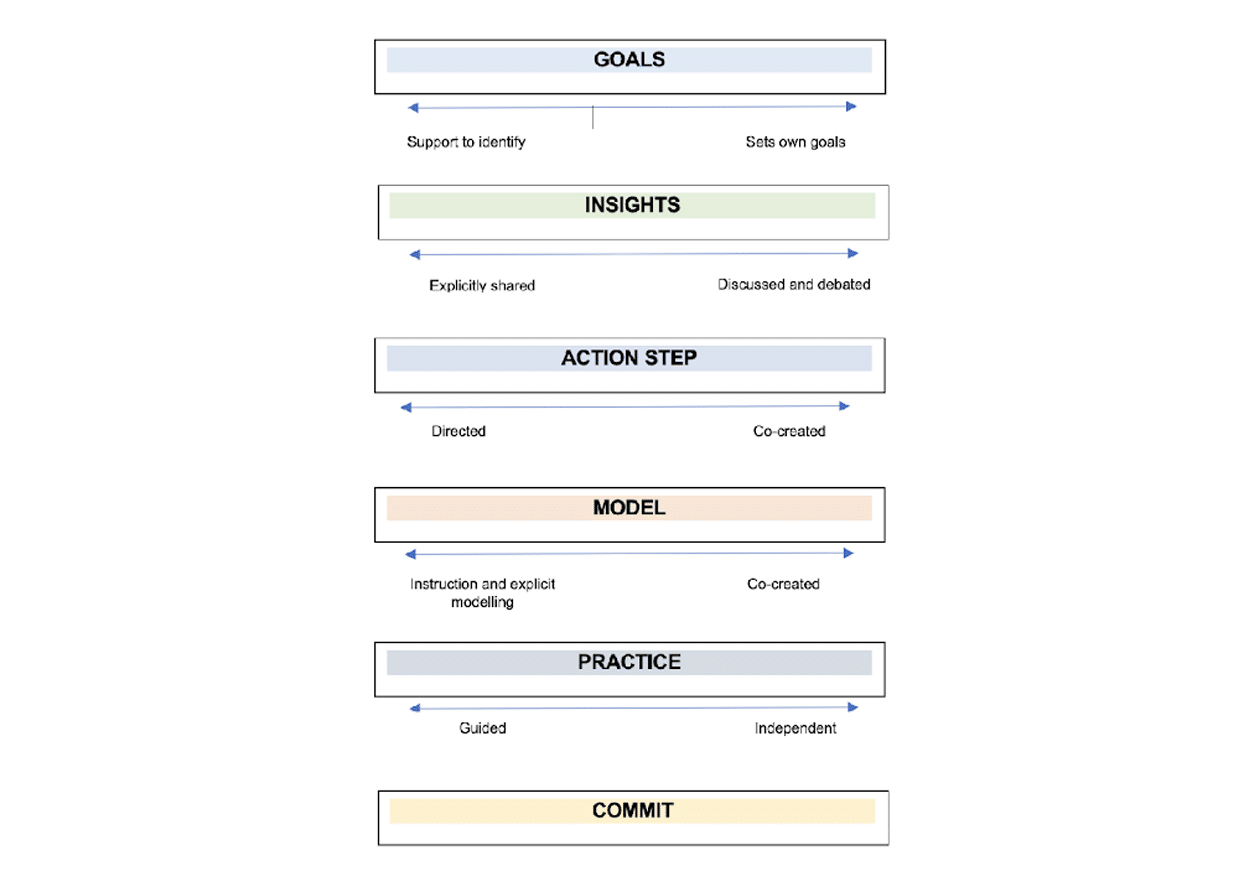
Click images to enlarge
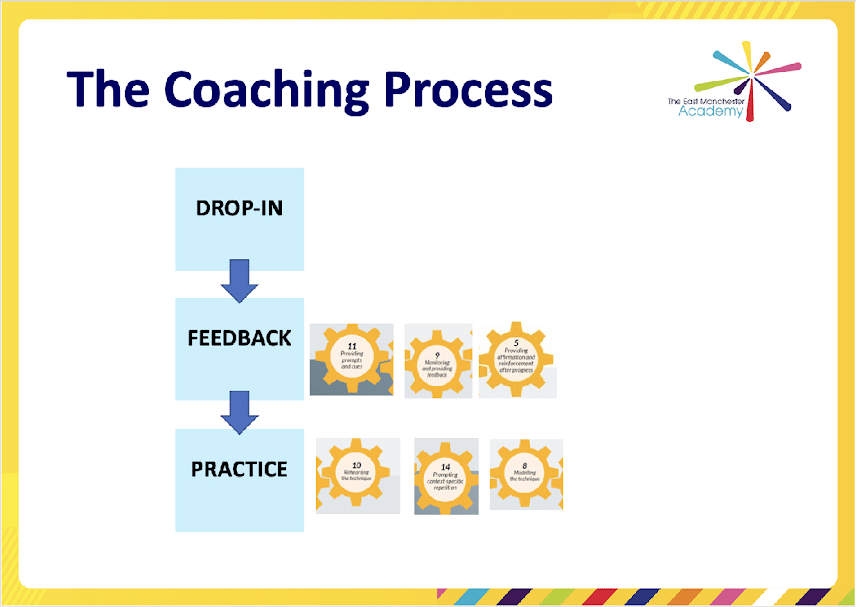
Culture First: Coaching as a Reflection of Who We Are
Coaching in Context
One of the biggest lessons I’ve learned is that coaching doesn’t exist in a vacuum. It’s shaped by the climate, culture, and context of the school it lives in. In one of our schools, where behaviour was a challenge and the improvement journey was intense, coaching became hard to embed. Teachers were already under strain, and the trust needed to come first.
In more stable environments, coaching landed better—but we still saw variations. That made me reflect: we were trying to drop in a model before defining what kind of organisation we wanted to be. We needed to start with culture, not coaching.
Defining Our Values
So we paused. We came together as a trust and asked, What kind of professional culture do we want to create? From that came our “Growing Great People” Charter, rooted in three core values: Excellence, Care, and Respect.
We took those values and translated them into coaching behaviours. For example, under “Respect”, we expect our coaches to listen to understand, to value the expertise of others, and to be honest and authentic. Coaching became not just a process—but a way for our schools to live their values in every conversation.
Clarifying the Why: Coaching with Purpose
Asking the Right Questions
Another shift in thinking came when I was asked, If coaching is the answer, what’s the question? That stuck with me. Why were we coaching? What problems were we trying to solve?
Each of our schools had its own answer. At East Manchester Academy, the goal was to embed consistent routines in classrooms. At another school, it was about fostering reflective conversations where those hadn’t happened before. That helped us realise: coaching must be tailored to context, but unified by purpose.
Aligning with Professional Development Goals
We now anchor all of our professional learning in a clear vision: to empower teachers as professionals. Coaching isn’t something we do to teachers—it’s a way of working with them to reflect, improve and grow.
Our central question became: How do we keep teacher agency at the heart of what we do? From there, we built a platform, co-created a Teaching Charter, and outlined what excellence looks like in our trust.Coaching supports that vision—not with checklists, but with thoughtful, reflective questions.
Clarifying the Why: Coaching with Purpose
Aligning with Professional Development Goals
Our coaching model now isn’t really a model at all—it’s a framework of shared reflective questions. For example:
- What are the core concepts of your curriculum?
- How are they sequenced, and is the sequencing working?
These questions help teachers think deeply about their practice and help coaches facilitate meaningful dialogue. It’s not about giving answers—it’s about asking better questions
Using Video to Make Learning Visible
We use IRIS Connect to support this work. By capturing classroom practice and coaching conversations, we give teachers and coaches a window into reflection that can be revisited, shared, and built upon.
Video allows for professional learning that’s contextual, flexible, and embedded—not bolted on. It’s a key part of how we support reflection across the trust.
Breaking Down Barriers: Moving Beyond Appraisal
Replacing Performance Management with Growth
One major barrier we encountered was the old appraisal system. While we talked about trust and empowerment, our policies still linked pay to performance. That contradiction undermined our coaching culture.
So we changed it. We removed performance-related pay and traditional appraisal, and replaced it with a Professional Learning and Improvement cycle. Now, teachers set development goals, draw on resources (including IRIS Connect), and engage in conversations that are about growth—not judgement.
This shift has been transformational. It’s helped us align values, build trust, and create space for genuine dialogue.
Final Reflections: It’s Not Just What We Do, It’s How We Do It
I’ve come to believe that the success of coaching depends far more on how it’s done than what is done. You can have the best model in the world—but if it’s implemented without care, without purpose, and without culture, it won’t make the impact we need.
At GMET, we now see coaching as a core part of our identity, not just our CPD strategy. It’s how we live our values, develop our staff, and shape the kind of schools we want to be.
If you’re asking yourself whether your coaching approach is working, try asking a different question:
- What kind of conversations are happening in your school—and what kind of organisation do those conversations reflect?
Thank you for being part of this conversation.
About the Author
Sam Gibbs leads Curriculum and Development for The Greater Manchester Education Trust. With her extensive experience as an English teacher, school leader, and educator, she has delivered evidence-based training on curriculum design and implementation to primary and secondary schools nationwide. Sam is highly skilled in guiding schools to adopt effective curriculum strategies that are grounded in educational research, ensuring that both teaching quality and student outcomes are consistently improved. She is also the co-author of The Trouble with English and How to Address It: A Practical Guide to Designing and Delivering a Concept-Led Curriculum

Get blog notifications
Keep up to date with our latest professional learning blogs.
By clicking Subscribe you consent to us contacting you regarding our products and services, as well as other content that may be of interest to you. You also consent to us storing your personal data to provide you with the content you are requesting. You can unsubscribe at any time. To find out more about how we manage your data, please review our Privacy Policy.