How Classroom Observation Supports Great Teaching: A Detailed Guide
- Last updated: 1st October, 2026
- Shawn Edmondson
Contents
Introduction
Classroom observation underpins the very best professional development (PD). Watching others (and yourself) in action in the classroom can be a revelation.
But, observations are sometimes disliked by teachers. Why? Because they’re often tied to performance evaluation – not learning.
This needs to change!
In this guide we share everything you need to know about effective and empowering classroom observation. We’ll look at what the research says and how to shift the culture of observation in your school.
Why is classroom observation so important?
The quality of teaching matters most
The most important school-based factor in student achievement is teaching quality.
It’s 2-3 times more important than any other school factor (e.g. leadership, teacher collaboration or the curriculum).
The difference in student performance that can be attributed to the quality of teaching is as much as 20%.
Instructional leaders, policy makers, and researchers are asking: what determines teacher effectiveness? And what are the best ways to improve it?
To improve the quality of teaching, you need PD that works
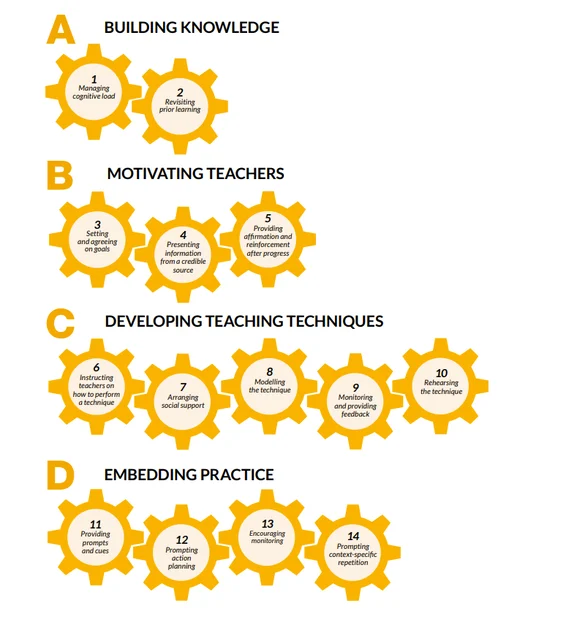
To impact student achievement, professional development needs to include specific building blocks.
The Education Endowment Foundation (EEF) calls these “mechanisms”, and identified 14 of them in a recent meta-analysis. They categorized them in these four groups:
- Building knowledge.
- Motivating teachers.
- Developing teaching techniques.
- Embedding practice.
The EEF found that the more of these mechanisms PD included, the greater impact on student achievement. They also found evidence to suggest effective PD programs might be more likely to include something from each category.
Unfortunately, teachers rarely get professional development that includes a range of these mechanisms. In a 2018 survey, only 38% of teachers in England agreed that ‘time and resources allocated to professional development are used in ways that enhance teachers’ instructional capabilities’.
Many of the PD experiences outlined above have something in common: they need observation and feedback.
Credit: Education Endowment Foundation
Classroom observations are powerful, when done well
Unfortunately in US schools, classroom observation tends to be infrequent, inconsistent, and often tied to performance evaluation.
Many teachers only get feedback on their teaching through mandatory classroom observations. These are usually conducted by a principal or a member of the Senior Leadership Team (SLT).
There’s a lot of data highlighting how ineffective these observations are. And, educators agree that they’re not working.
According to a SmartBrief poll:
- 70% of teachers reported that traditional observations don’t give the meaningful and actionable feedback they need
- 62% of school leaders acknowledged that the evaluation systems at their schools are not effective in supporting their teachers’ development
Teacher observation vs classroom observation feedback
But – classroom observations, particularly with more than one observer, can provide teachers with the feedback they need to improve their teaching (Measures of Effective Teaching (MET) project).
Tom Kane, Professor of Education and Economics at Harvard’s Graduate School of Education and leader of the MET project explains:
“If we want students to learn more, teachers must become students of their own teaching. They need to see their own teaching in a new light.”
“This is not about accountability. It’s about providing the feedback every professional needs to strive towards excellence.”
For classroom observation feedback to be most impactful, it’s important to reflect on the lesson as a whole and move the conversation away from the teacher, focusing instead on the teaching in the classroom – ensuring the focus is objectively on the key aspects of effective pedagogy, rather than on individual performance.
Think about the professional development structures or programs that already exist within your school (e.g., lesson study, teaching triads, or peer coaching). Lesson observation probably plays a key role in each of these. If it doesn’t, including some form of observation will make the process richer and more effective.
How to overcome the barriers of classroom observation
Staff shortages, schedules and logistics make it hard for schools to provide these experiences. This is where video makes a real difference.
Video allows teachers to record their teaching when others can’t be there. By uploading these videos to a web platform like IRIS Connect, teachers can easily share their lessons with colleagues and coaches to receive feedback. These colleagues can watch and provide detailed notes, embedded in the video, when their schedule allows. By removing the need to be in the same place at the same time, IRIS Connect makes classroom observation and feedback possible.
It is possible for teachers to have all of the experiences that make professional learning effective.
Find out how IRIS Connect can help you to bring your classroom observations to the next level
The Cycle of Inquiry
The observation – feedback loop is also the engine that drives a Cycle of Inquiry. These Cycles are a structured process for teachers (often working in professional learning communities or PLCs) to continuously improve their instruction.
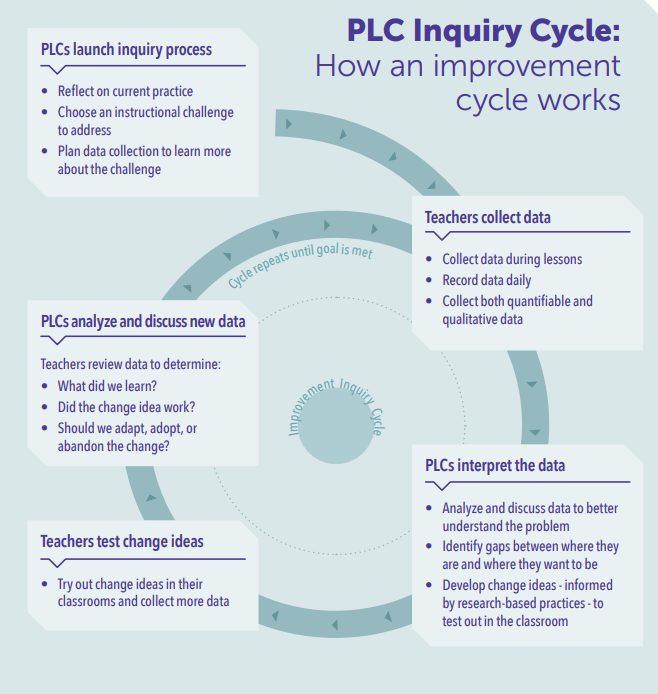
Credit: Literacy Improvement Partnership
In a typical Cycle of Inquiry, teachers:
- Reflect on their current practice and choose a focus for improvement.
- Collect data about what’s happening in their classrooms.
- Interpret the data and develop ideas for change.
- Implement the changes to test them out.
- Collect more data to determine the impact.
Notice that this cycle mentions ‘reflecting’ and ‘data’ at almost every step.
There’s no better method than observation to reflect on the teaching and learning in the classroom and to collect data on the impact of instructional changes.
The PLC allows teachers to share their practice (ideally via video) with colleagues. They can analyze what went well, spot opportunities to improve, and collaborate on a plan for next steps.
Summative vs formative observations
The problem with traditional, summative observations
You’ve all been there: senior member of staff at the back of the classroom, with a clipboard.
The format for classroom observation was traditionally focused on performance evaluation. The observer records subjective observations using unvalidated protocols. Doesn’t sound great does it?
There are a host of issues with this approach:
- They’re anxiety inducing for the teacher.
- Classroom dynamics are affected by the presence of an observer, particularly if it’s a member of the senior leadership team.
- They’re usually scheduled in, virtually ensuring that the lesson is not ‘typical’.
- The context limits the effectiveness of any feedback provided.
Change is happening. There’s been an effort to make classroom observations more effective by focusing on teachers’ development instead of performance management.
💡Tip: When observations are done for evaluation purposes (which is inevitable), they should be conducted by trained observers using standardized, validated rubrics.
Shifting to formative observations
Experienced educator and award winning blogger, David Didau, shares useful guidance for observations and how to give classroom observation feedback:
- Don’t make assumptions: Remember that you don’t know the full context. The teacher is the expert on this lesson, this class, and these students. Follow their lead.
- You’re there to learn: Ask thoughtful questions that will help the teacher reflect on their lesson. For example, “What do you think the impact of x might be?” or “How might you have done that differently?” Keep your opinions to yourself unless they’re asked for. Resist the self-indulgent urge to share what you would have done.
- Make it reciprocal: We learn more from observing others than from being observed. Therefore, providing teachers with the time to observe each other is one of the most powerful ways school leaders can support them.
- Focus on instructional support: There’s a tendency for teachers to focus on improving the ‘easy’ things, such as providing effective emotional support to students and behavior management. Once these are under control, we’re content. The harder task of focusing on instructional practice doesn’t get the attention it needs. Instead, teachers must deliberately practice the elements of great teaching. Lesson observation can be used as a tool to enable the guided practice of these instructional techniques.
- Watch the teacher, not the kids: If we really want to provide instructional support, we need to observe what the teacher is doing. This results in sustained progress on instructional quality, rather than short term results.
The line between accountability and professional development
There is often confusion between classroom observation as part of an accountability framework and observation for professional development. This can permanently damage teachers’ trust and confidence in observation as a tool to help them improve. Accountability is important, but it must be done thoughtfully.
It’s essential to ensure there is a clear distinction between the two.
How to do classroom observations for accountability well
Professor Robert Coe, Director of the School of Education at Durham University, offers the following advice:
- “Apply a critical research standard and the best existing knowledge to the process of developing, implementing and validating observation protocols.”
- “Stop assuming that untrained observers can either make valid judgements or provide feedback that improves anything.”
- “Ensure that good evidence supports any uses or interpretations we make for observations.”
Use IRIS Connect to support your current PD activities and elevate your teaching & learning quality
Shifting the classroom observation culture in your school
How to observe lessons effectively
Digging your classroom observations out of the summative rut can be a challenge. It requires a cultural shift and a commitment from school leadership to focus on development rather than supervision. A good starting point is to assess how observations are currently used at your school.
Ask yourself these eight questions about classroom observation in your school:
- As part of the senior leadership, how do you feel about classroom observations at your school?
- Are your teachers confident in letting people observe their lessons?
- Are teacher observations always centered around performance management?
- Does lesson teacher observation feedback consist of tick boxes against criteria or a more contextualized, meaningful discussion?
- Do teachers get an opportunity to see great practice from around the school?
- Is there a fear of risk-taking or experimentation?
- Are there pockets of outstanding practice, but a difficulty in sharing this across the school?
- Are there opportunities for peer and self-review?
Let’s be honest, classroom observation is hard.
It’s uncomfortable to reflect on ourselves and our performance — especially when we’re seeing it on video. And that’s exactly why it’s so effective.
Observation provides us direct access to fundamental truths about what’s happening in the classroom. Teachers can only improve if they confront these truths and make good decisions about them.
Helping teachers to embrace this challenge may require a cultural shift. Resources like this guide provide a starting point for helping to see observation in a new light. But, the real shift will happen when they see it actually improve their teaching.
As Michael Fullan (2011) put it:
“…You can’t make people change, and rewards and punishment either don’t work or are short lived—the only thing that works is people’s intrinsic motivation, and you have to get at this indirectly… it is not inspiring visions, moral exhortation, or mounds of irrefutable evidence that convince people to change, it is the actual experience of being more effective that spurs them to repeat and build on the behavior”.
10 suggestions for shifting the culture of observation in your school
1. Create a shared vision for great teaching and learning
How can a teacher make significant instructional changes when they don’t know what the changes actually look like?
Give teachers the opportunity to see great teaching in action – it’s a powerful learning experience. Use video to build a bank of shared practice clips to overcome the time and cost barriers of releasing teachers from lessons to observe one another.
💡Have IRIS Connect? Create a Group in IRIS Connect. Ask your lead practitioners to share clips from their lessons so that all of your teachers can see them in action at any time.
2. Provide opportunities for regular peer observation
Observations are excellent learning opportunities for both the teacher and the observer. When you’re the observer, you can see a colleague modeling a particular teaching strategy to gain a deeper understanding of the strategy. When you’re being observed, you can request feedback and coaching from your colleagues to help you refine your instructional strategies.
💡Have IRIS Connect? Add time-linked notes to explain your thinking and the decisions you made, making the tacit explicit.
3. Consider cross-department 360 observations
Teachers in different departments often rarely cross paths in their day-to-day lives. Peer observation of a different subject specialist may unlock interesting insights and learning opportunities. For example, seeing your students in another setting can give a different perspective.
4. Ask your teachers what they want
Ask what your staff find valuable and what they don’t. What type of development opportunities do they need? Who would they like to observe and who would they value feedback or coaching from? Involving teachers in decisions will create buy-in to the process and will avoid wasting time and money on activities that teachers don’t find useful.
We ran a survey of 1,000 teachers to learn what professional development activities they would prioritize if they were in control of their PD. Ask your own teachers their opinions to see what they think.
5. Focus on specifics, not generalizations
Developmental teaching observations should look at specific strategies or elements of a lesson rather than the lesson as a whole. For example, look only at questioning, feedback, wait time, or a specific student’s learning. This will ensure that the follow up discussion or feedback is focused on specific areas for improvement.
6. Take the opportunity to record and revisit
Giving feedback to teachers after observation relies on the memory of the observer. The effectiveness of feedback diminishes over time following a teacher observation. In the busy life of a teacher, it’s near impossible to accurately recall exactly what happened in a lesson last week. Recording lessons allows for contextualized feedback at a convenient time. It provides an opportunity to revisit and learn from the experience time and time again, turning one lesson into multiple learning opportunities.
Please find more information about this below.
💡 Have IRIS Connect? Use the time-stamped comments tool to add contextualized feedback to a lesson video and increase dialogue around teaching and learning.
7. Equip teachers with effective discussion points
Develop a set of questions that will keep post-observation discussions focused. These can help teachers dig deeper into teaching and learning. Read Headteacher Tom Sherrington’s blog on observing a sequence of lessons for some excellent question ideas.
💡 Have IRIS Connect? You could add these questions to a number of Forms and share them with your colleagues to help analyze their video reflections and gain a more objective insight into the teaching and learning.
8. Improve developmental feedback skills
Give your staff the tools and training needed to provide effective developmental feedback. This includes:
- Objective-setting
- Focusing on specific observable behaviors
- Identifying next steps
Putting the teacher’s development at the center of observation
Read how feedback went from crippling critique to collaborative conversation for Josh Roy in the “Lesson observation feedback” section below.
9. Enable self-observation
Observing yourself on video is like holding a mirror up to your teaching practice. Seeing yourself as your students see you provides important insights into your impact as a teacher. This deeper understanding makes conversations with colleagues about your teaching more productive. Read more about self-reflection.
10. Widen your professional learning network
Why restrict your teaching observations to the confines of your school? If you want to use observation as an opportunity to see truly new practices, then look beyond your school gates. Use your connections with other schools to share practice, observe and collaborate more widely.
Lesson observation feedback: How to go from crippling critique to collaborative conversation
We asked Josh Roy, a Teacher at Ernest Bevin, to share his thoughts on how classroom observation and feedback can be done in a thoughtful way that benefits the teacher.

“Having trained in a challenging environment, being deprived of meaningful (in-school) feedback for about two years, and being bombarded with observations from all possible sides, I feel I should be better placed than any to take criticism. Don’t get me wrong, I recognize that feedback is fundamental for my development as a teacher. But, I still can’t help the very human reaction that I believe exists in many of us, where negative feedback, however it’s dressed up, doesn’t exactly inspire motivation and joy.
“In fact, in my short career, it seems no individual is entirely impervious to the feeling of impending doom caused by the inexorable classroom observation. From the perspective of a recently qualified teacher who’s gone through just about as much feedback as a teacher does in their career, feedback should be reconceptualized from the ‘positive’ and ‘negative’ model to a collaborative and cumulative conversation.” – Josh Roy, Teacher at Ernest Bevin.
What is this feeling and why does it affect teaching?
The observation feeling can erode the teacher’s creativity, and can be especially detrimental to less experienced teachers’ growth and development. Focus is placed on a brief moment in time within which you must either shoehorn all of your best tricks or recite, verbatim, your knowledge of your respective subject. Feedback often slips into the natural ‘I would have done it like this’, which while well-intentioned, can only be a ‘quick-fix’ for a singular and isolated moment.
This discourages autonomy and steer teachers away from exploring what works best for them. This is particularly true when feedback is a solution that fits with the practice and style of the teacher giving the advice, not the teacher being observed; teaching is profoundly human and therefore individual. Providing feedback in this way can efface an individual’s style and discourage critical and reflective practice. It can lead recipients of feedback to feel as if their wisdom is being challenged, and this can be taken personally because we work in one of the few professions where our personal values are so closely entwined with our professional ones.
When this has been acknowledged in how feedback is given it has not only improved my practice, but made me far more willing and confident in improving my practice. We all have something to bring, and observers too have the experience to help shape us into the best practitioners we can be. This can be better recognised through observation and feedback.
But how could this process go from critical to collaborative?
Teachers should not leave feedback thinking there is anything ‘inferior’ with their practice, but should be energized by the prospect of developing. It should not be conceptualized as a performative measure, where one judges the other, but a supportive one, where one collaborates with the other.
The difference may seem pedantic, but for me the difference in how this kind of effective feedback made me feel, and subsequently respond, has been huge. After cumulative and collaborative conversation, the focus shifted from ‘what should you keep doing and what you should stop doing’, to ‘how can you evolve your practice continually to adapt to the ever-changing, and challenging, educational landscape in which we work?’
The best observers have devised supportively phrased questions based on their observations. Open conversation starters and points for discussion made it a joint, evenly footed process. Two aspects in particular have helped inspire a more motivated response:
Directly involve the practitioner in creating the solution
- “What part of the activity could be altered to promote engagement?”
- “At which point in the lesson do you think incorporating *insert specific strategy* would be most effective? Why?”
- “How could this activity/lesson be slightly reframed to mesh more closely with the school’s ethos?”
Know the area you want to develop further based on, but not tied to, your own expertise
- “In the past, I’ve found X useful; how could you adapt this/ try it out in your own way?”
- “Research suggests that X is beneficial for *insert priority group*, how could you apply this to the way behavior is managed in future?”
- “That idea is good, but may be difficult to implement over time. I’ve found X works better over time – how can you adapt your idea as part of regular low-effort but high-impact practice?”
These examples are somewhat generalized and non-specific, but are exemplars of how the recipient, and what they bring to the profession, can be respected and uplifted as valuable.
Does this make classroom observations less ‘measurable’?
This method is simply a different framing of the process. It allows creative and critical reflection on all areas in which a teacher can develop – including allowing more space for maximizing upon the teacher’s individual strengths, rather than solely focusing on ‘fixing’ poor practice. In this way, teaching observation and feedback is reconceptualized as something that recognizes and rewards constant development in all areas of a teacher’s individual practice within the parameters of the observer’s expertise.
Teachers can be molded by the observer’s expertise, rather than confined to strategies that may not fit their teaching style and are not co-created in a teacher-observer space.
Feedback can be a supportive reminder that we are part of a profession that demands constant and creative evolution, and so we should evolve collaboratively.”
Video observation - is it better than traditional classroom observations?
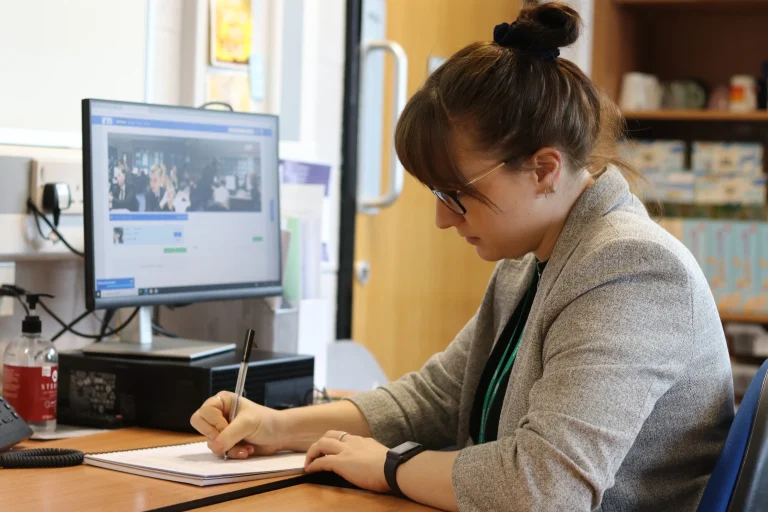
There’s no question that classroom observation is critical to effective professional development. But logistical challenges mean that schools often struggle to give teachers opportunities to take part.
Luckily, cameras are now ubiquitous. We all have a digital video recorder in our pocket, making recording lessons an easy solution.
Video-based classroom observations have major advantages over traditional methods. They can overcome many of the challenges that have plagued the classroom observation process for decades. And, support for using video among educators is rapidly growing.
In a recent SmartBrief poll:
- 91% of teachers felt that simply filming their teaching practice would help them to improve.
- 76% said they would be willing to select and submit a video for use in a formal observation.
This growing support isn’t just coming from teachers.
- 85% of school leaders said that using video for classroom observations would help them to provide teachers with more meaningful and actionable feedback.
Educators are seeing the huge potential that video has for helping them to push their practice to the next level – and improve outcomes for learners.
So exactly how is using video for classroom observations better than in-person observations?
7 benefits of video-based classroom observations
1. Acceptance
Teachers can struggle to accept feedback. This isn’t because they don’t want it, but because they don’t believe it’s accurate, reliable, or relevant. Video-based classroom observations provide evidence and a shared reference point for both teacher and observer. They make feedback more objective, specific, and acceptable to the teacher.
2. Validity
Validity refers to whether the observation and its results are measuring what they are supposed to measure. That means that the observation accurately reflects the teacher’s abilities, methods, and effectiveness in the classroom. Video observation comprehensively captures the full spectrum of classroom interactions, including non-verbal cues, classroom dynamics, and teacher-student interactions. Although there may be differences of opinion about the implications of what’s in the video, it does provide an unambiguous record of what actually happened. In contrast, traditional methods rely on memory or notes. If there’s a question about what actually happened during the lesson, referring to the video can usually clear up any misconceptions.
3. Accuracy
Accuracy refers to the correctness and precision of the observations made. Most in-person classroom observations don’t provide a full and clear picture of a teacher’s practice and classroom dynamics. Yet, accuracy is key for providing relevant and actionable feedback.
Video observation provides a more comprehensive view that you can pause, and rewind. With more time to look at the intricacies of a lesson, the observer can explore beyond what they might have seen in real-time.
4. Contextualized feedback
With in-person observations, feedback is often hours or days after the lesson took place. It’s a memory and the feedback is inevitably broad and subjective.
Video-based classroom observations allow the observer to make notes and comments directly within the video timeline. This makes them contextualized and specific – important elements of effective feedback.
5. Perspective
Teachers never see or hear 100% of what’s happening during any given lesson. That means that when a teacher thinks about a lesson, they are only reflecting on a fraction of it.
Confirmation bias suggests that we are more likely to notice and remember things that confirm what we already believe to be true. Therefore it’s unlikely that the 20% teachers notice is where they need improvement. Video observations allow a teacher/observer to reflect on the entire lesson, and see it from the learners’ perspective. This is a game-changer for understanding teaching and learning through classroom observations.
6. Time
It’s been recommended in the past that school leaders spend 25% of their time on observation and feedback. But with already high demands on educators’ time, this is almost impossible to realize without the right tools and support.
Video-based classroom observations provide flexibility for observers to view and provide feedback on lessons at a time that suits them, increasing the number of opportunities as well as effectiveness.
7. Location independence
Conducting classroom observations via video technology eliminates the need to be in the same classroom as teachers. This reduces potential classroom distractions, and gives opportunities for developmental classroom observations for teachers that can’t physically be there.
The use of video in Teacher Training Observation
An in-class observer can make the most confident teacher sweat. So, for trainees nerves and distraction can take over.
The seven benefits of video-based classroom observations above hold true in initial teacher training. In addition, video offers a less intrusive approach than in-person observations.
For trainees, recording their lesson and sharing it for feedback gives a sense of control, increases their confidence, and lets them focus on delivering a great lesson.
The bonus is that they can watch the video back, reflect on their teaching, and draw meaningful conclusions for their professional development.
💡 Top Tip: Establish the use of video with your trainees early on during micro-teaching sessions. Get them to watch and analyze clips together with peers to increase their comfort in regularly videoing themselves which sets them off to a promising career as a reflective teacher.
Enabling effective online classroom observations
IRIS Connect also enables classroom observations when teaching online.
Our platform provides a screen capture tool so you can record your webcam and screens during online lessons. Just like when using our mobile recording app, they are automatically uploaded to your private account on the IRIS Connect platform. From there, you reflect on your lesson and then share the video with a colleague for feedback and discussion.
Discover the power of video-based classroom observations with IRIS Connect
Sources
- Hanushek, Eric A., John F. Kain, and Steven G. Rivkin. 1998. “Teachers, Schools, and Academic Achievement.” New York: National Bureau of Economic Research Working Paper No. 6691
- https://ies.ed.gov/ncee/edlabs/regions/west/relwestFiles/pdf/REL-West-4-2-3-4-Literacy-Improvement-Partnership-Inquiry-Cycles-Infographics-508.pdf
- Kane, Thomas J., and Douglas O. Staiger. 2008. “Estimating Teacher Impacts on Student Achievement: An Experimental Evaluation.” New York: National Bureau of Economic Research Working Paper No. 14607
- Hanushek, Eric A., and Steven G. Rivkin. 2010. “Generalizations About Using Value-Added Measures of Teacher Quality.” American Economic Review: Papers & Proceedings Vol. 100
- Joyce, B., and Showers, B. (2002). Student achievement through staff development (3rd ed.). Alexandria, VA: Association for Supervision and Curriculum Development.
- Showers, B., Joyce, B., and Bennett, B. (1987). “Synthesis of research on staff development: A framework for future study and a state-of-the-art analysis.” Educational Leadership, 45 (3), 77–87.
- Best Foot Forward Project – https://cepr.harvard.edu/best-foot-forward-project
- Fullan, M. (2011). Change leader. San Francisco, CA: Jossey-Bass.
Get blog notifications
Keep up to date with our latest professional learning blogs.
By clicking Subscribe you consent to us contacting you regarding our products and services, as well as other content that may be of interest to you. You also consent to us storing your personal data to provide you with the content you are requesting. You can unsubscribe at any time. To find out more about how we manage your data, please review our Privacy Policy.
Interested to find out more?
If you’d like to find out more about IRIS Connect and how our solution can help you to get the most out of your classroom observations and provide high qualitative PD for your teachers, get in touch!